As Morocco’s intellectual landscape evolves, new questions emerge about the lived realities of women, and how gender, power, and identity are being defined.
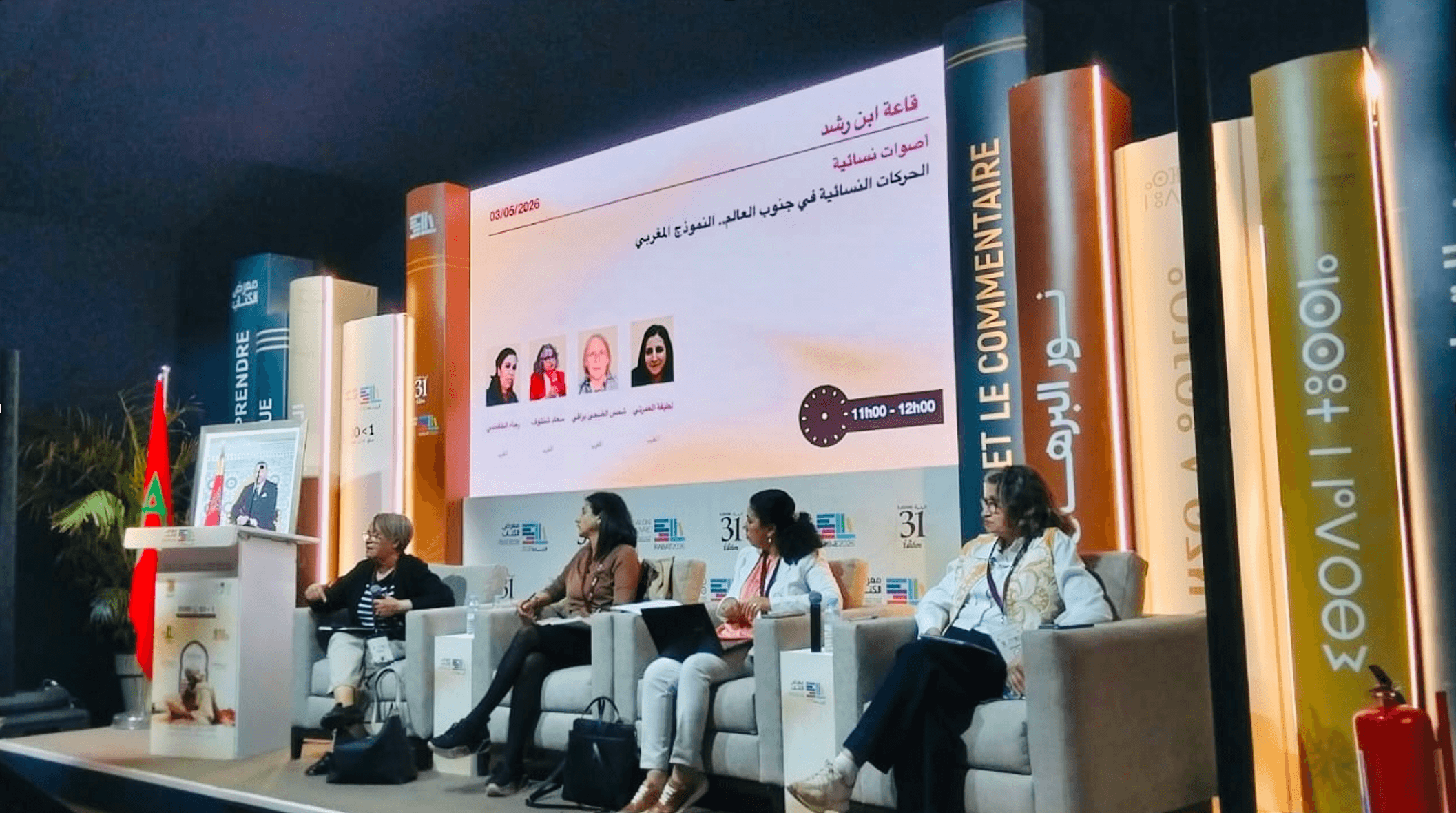
This was the topic of discussion on May 3rd, at the 31st International Rabat Book Fair, where three researchers shared their expertise. Latifa Laamrati, a PhD holder specialized in languages and cultures of the Iberian and Hispanic American world and a feminist advocate, said: “feminism is one of the most influential movements that brings about significant transformations in society“. She also emphasized that issues of gender and race originate from historical roots in colonial structures, which continue to shape contemporary social relations.
She elaborated on how reclaiming lived experience is a source of knowledge, challenging what she calls “epistemic dominance”, criticizing the tendency to treat Western frameworks as universal while marginalizing other forms of knowledge.
Building on this reflection, activist and professor Souad Chentouf examines in her work the complex reality of women in Morocco. She drew attention to the “care economy,” as a fundamental yet invisible sector of labour that sustains society, particularly through childcare and elderly care, largely performed by women, yet rarely recognized economically.
At the same time, she noted that even when women gain access to education and employment, which access remains controlled and shaped by restrictive conditions, including in politics and decision-making.
Adding another dimension, a consultant in intercultural communication, Chams Duha Bouraqi, introduces the notion of “border feminism,” which seeks to understand how identities are shaped at the intersection of cultures, migrations, and power relations. She explained: “Borders are not only geographical; migrant women carry borders in their bodies because they have been exposed to all forms of violence, both structural and institutional.”
Ultimately, the discussion converges on a central challenge: How can feminism in the Arab context balance universal human rights with local cultural specificities?