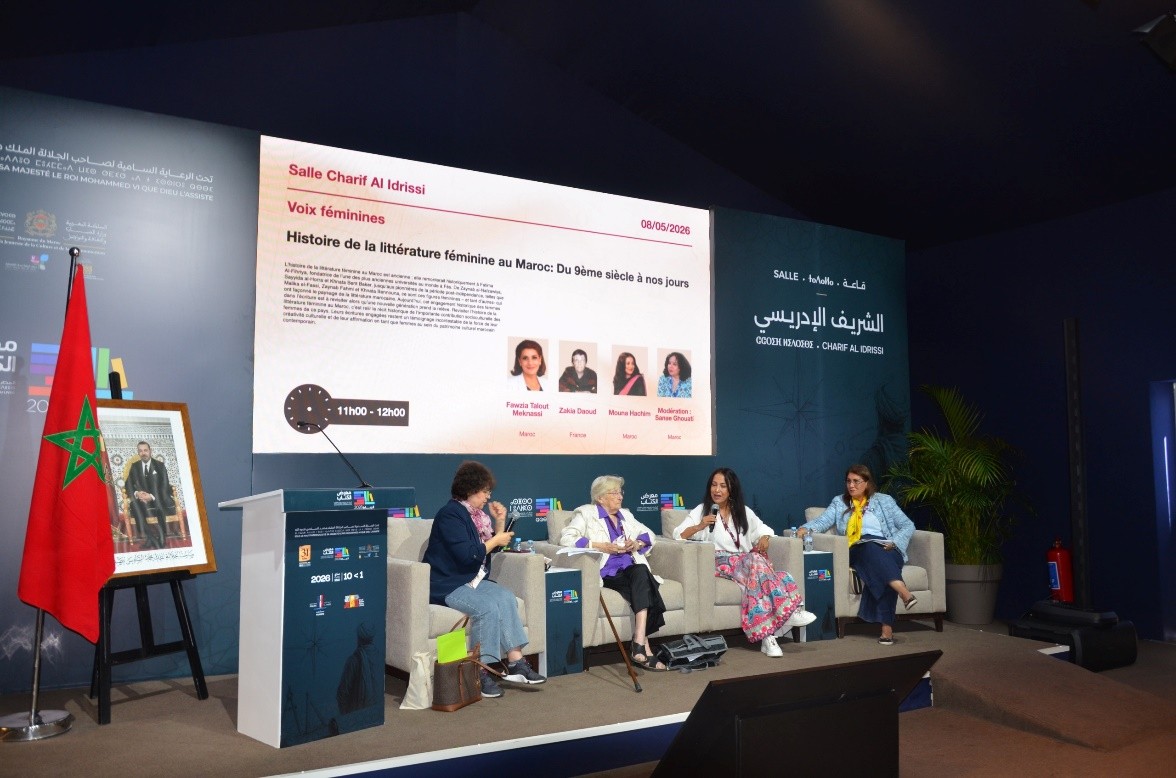
A cultural session at the International Publishing and Book Fair (SIEL) shed light on an insightful panel discussion entitled: “Voix Féminines: Histoire de la littérature féminine au Maroc: Du 9e siècle à nos jours.”
The session brought together three remarkable authors and historians: Fawzia Talout Meknassi, Zakia Daoud, and Mouna Hachim, author of Les Enfants de la Chaouia and Les Histoires Inattendues du Maroc. The discussion was moderated by Sanae Ghouati, who guided the audience through the intellectual and creative history of Moroccan women across several centuries.
Talout Meknassi expressed her fascination with the pioneers of contemporary Moroccan literature, including Malika el-Fassi, Fatima Mernissi, and Khnata Bennouna. However, she moved beyond the printed page to emphasize the importance of oral transmission and non-written forms of female expression.
She explained: “Moroccan women preserved collective memory not only through songs and poetry but through weaving, embroidery, and traditional crafts.” These practices were described as a form of “silent writing,” transmitting emotions, knowledge, social realities, and worldviews without necessarily passing through books or academic institutions. She added: “Women had always produced literature and knowledge long before modern publishing or formal education systems existed.”
Reinforcing these points, Zakia Daoud argued: “The real turning point came with women’s increasing access to education, journalism, and public spaces of expression.” This transition allowed the "silent writing" of the past to evolve into the bold, published voices of the modern era.
Mouna Hachim further highlighted the historical "invisibilization" of influential women poets, intellectuals, teachers, doctors, and cultural figures whose contributions have largely disappeared from historical records. She noted: “This erasure was linked both to patriarchal systems and to the lack of preservation for archives and cultural heritage in general.”
In conclusion, the conference called for deeper research and “cultural archaeology” to recover the forgotten voices of women throughout Moroccan and Arab history, effectively restoring their rightful place in collective memory.