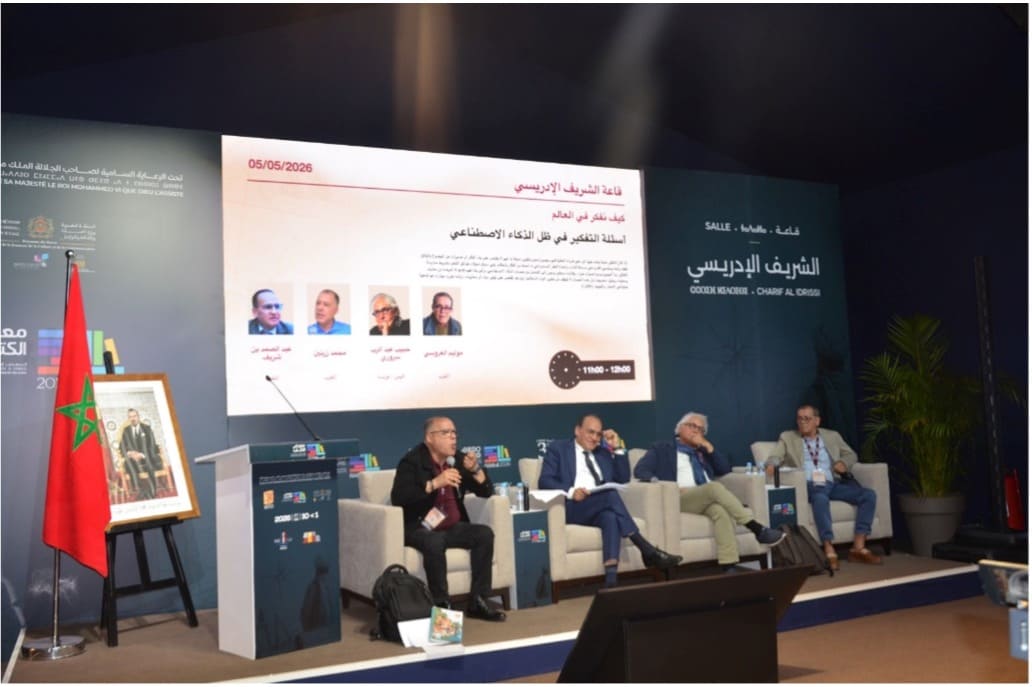
At the Rabat International Book & Publishing Fair (SIEL 2026), three researchers and technology experts shared their insights on the standing of human thought in the face of rapidly evolving artificial intelligence systems.
In today’s age, technology has become inevitable. From generating ideas for our homework to validating our lifestyle choices, we have become increasingly dependent on it at every step. Large Language Models (LLMs) have opened new fields of possibility, significantly advancing the speed of scientific research.
“The AI revolution is unlike any past scientific and technological revolution because it engages with thinking itself: the core of what makes us human,” said Habib Abdulrab Sarori, a computer science professor and acclaimed novelist. He highlighted the need for a more positive, symbiotic relationship with AI, pointing to its unique ability to connect complex and disparate fields of knowledge.
Moulim Al Aroussi, a Moroccan thinker specializing in aesthetics, expressed his fascination with a form of intelligence that transcends human memory through its sheer speed and efficiency. He noted, “Throughout history, humans have always asserted their dominance through their intellect. But for the first time, we are confronted with our limitations, pushing us to reflect deeply on what it truly means to be human.”
Mohamed Zernine, a Moroccan sociologist and pedagogue, drew on an anthropological perspective to interrogate how students and children will function in this new reality. He emphasized that the primary condition for true learning is "sustaining effort" a human trait that may be at risk in an age of instant AI results.
Ultimately, artificial intelligence is advancing at a remarkable speed, extending far beyond traditional human capabilities. As it challenges the very activity of the mind, it forces us to confront a final, pressing question: how will power and agency be redistributed in the age of AI?