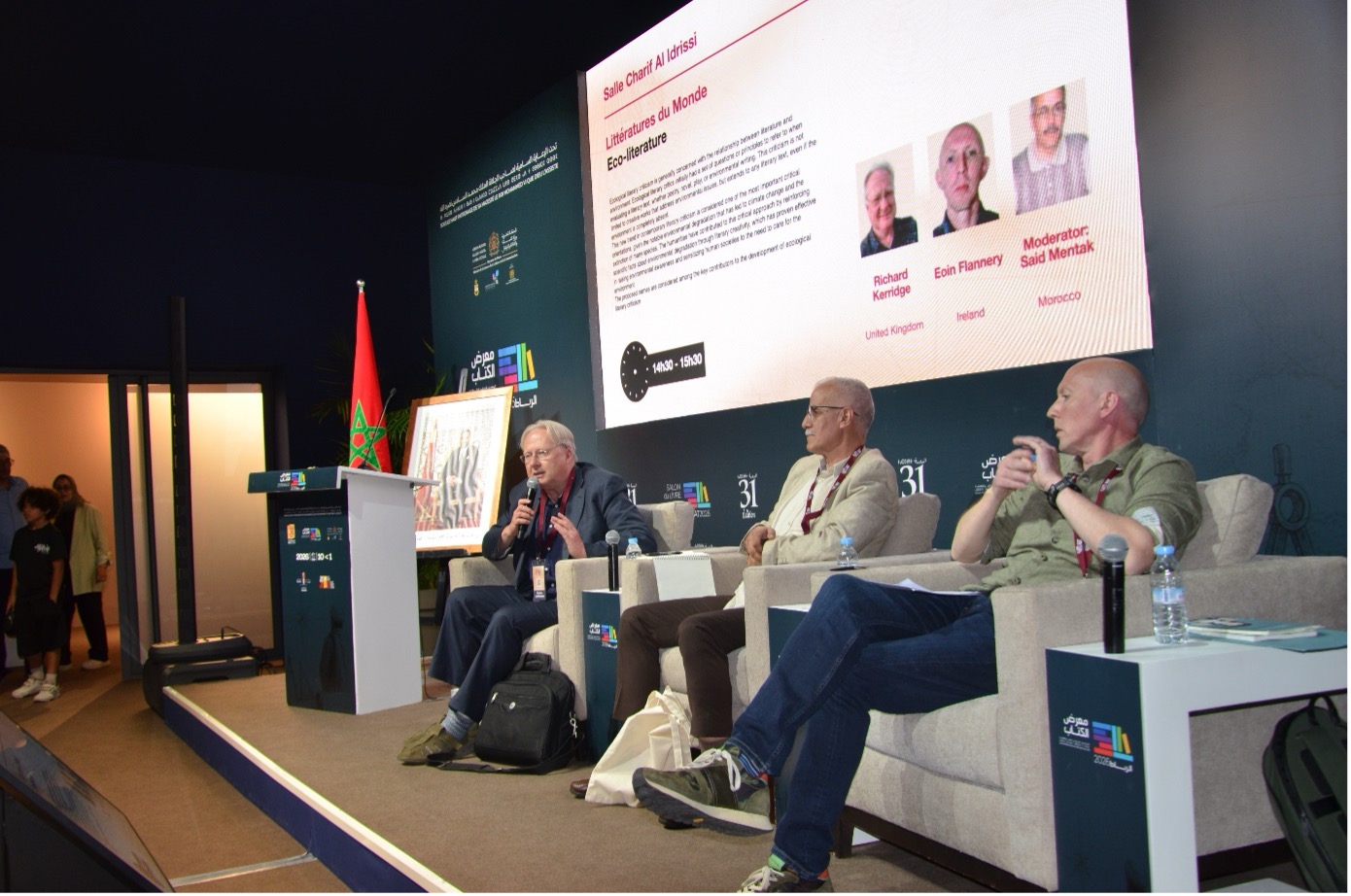
The SIEL 2026 in Rabat hosted a conference on Eco-Literature, exploring how contemporary literature engages with environmental issues and the relationship between humans and the natural world, while promoting environmental awareness and sustainability.
The discussion brought together key figures in ecological literary criticism, including Richard Kerridge and Eoin Flannery, and was moderated by Said Mentak.
The conference focused on ecocriticism as a major literary approach that examines the relationship between literature, the environment, and human responsibility toward nature.
Richard Kerridge discussed the evolution of ecocriticism through different stages. The first wave emerged as a reaction against abstract literary theories, bringing attention back to the physical environment and reintroducing nature writing as a serious literary subject rather than a symbolic idea.
The Environmental Justice Movement in the United States influenced the second wave. It focused on the links between environmental issues and social inequalities related to race, ethnicity, Indigenous communities, and social class, while criticizing the dominance of Western perspectives in nature writing.
The third wave, described as Posthumanist and Anthropocene ecocriticism, reconsidered humanity’s place within nature by challenging the idea that humans are separate from or superior to the environment.
For his part, Eoin Flannery explored how poetry can reshape our understanding of nature, presenting it as a powerful force in which humans represent only one element of a larger ecosystem. He also referred to the mythical civilization of Atlantis, submerged after a catastrophic event, as an example challenging the idea of human superiority.
Eco-literary criticism ultimately explores the connection between literature- whether novels, poetry, or other forms- and the environment. By raising awareness about climate change and ecological crises, it reminds readers that humans coexist with other living and environmental forces.