

Journal ISIC Beyond the Screen: Saving the Joy of Reading in Morocco
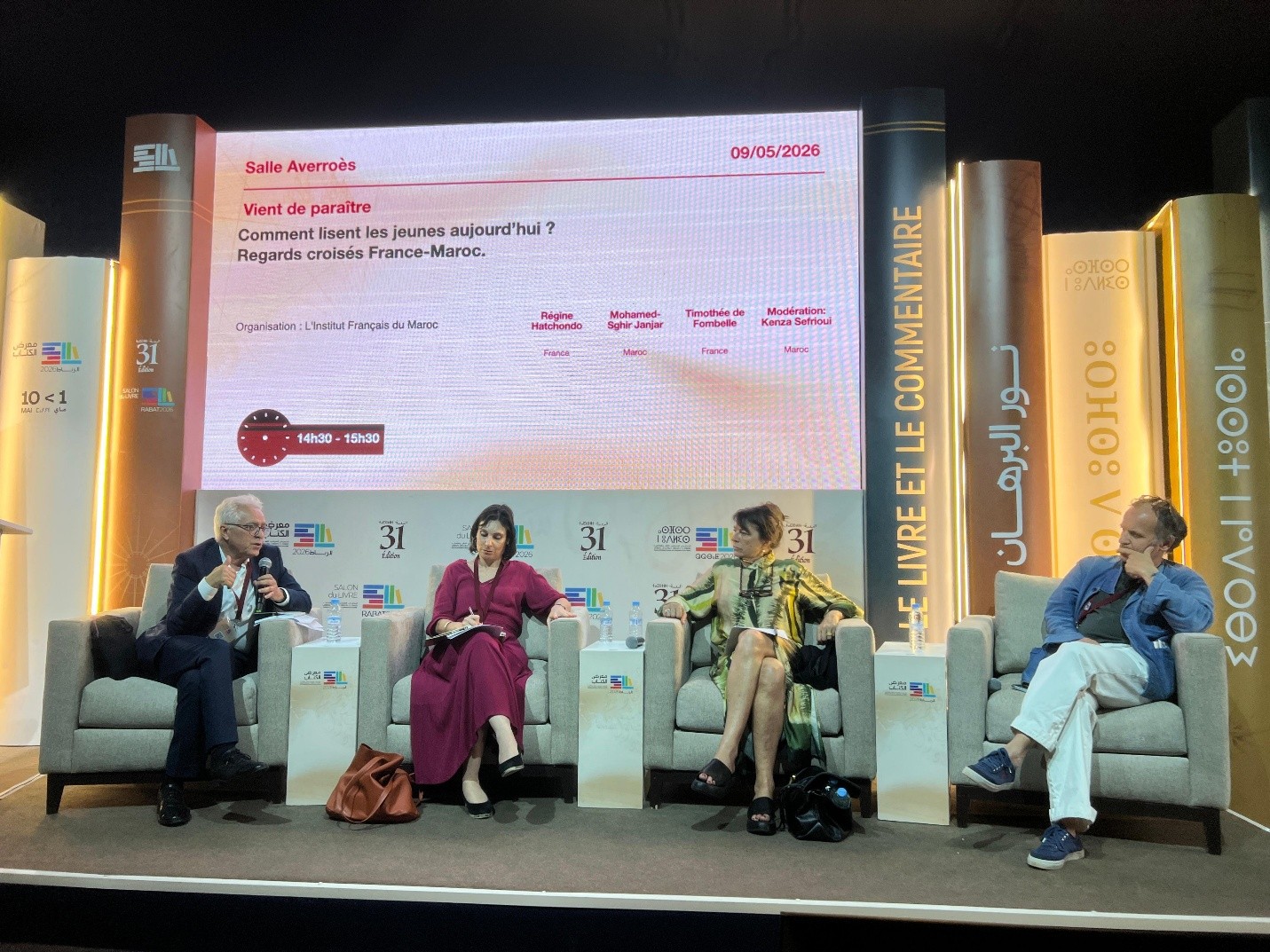
At the International Publishing and Book Fair in Rabat, the discussions held in the conference halls aim to raise awareness about today’s shifts in reading culture. In Averroes Hall, Régine Hatchondo, Mohamed-Sghir Janjar, and Timothée de Fombelle came together for a panel moderated by Kenza Sefrioui.
In Morocco, the real issue lies in the lack of statistics. Unlike France, which publishes annual cultural data on youth reading habits, Morocco has yet to establish a consistent approach to investigating the cultural behaviors of its population.
Unlike France, Morocco never experienced a dominant literary movement. Literacy and children’s education peaked in the 1990s, but the spread of smartphones and social media has since deepened the country’s struggle, fueling a growing crisis in reading culture. In France, 30% of teens aged 16–19 avoid reading altogether, with 67% distracted by phones and short videos. On average, a 16-year-old spends five hours on screens but only 14 minutes reading.
The main issue remains whether reading appears attractive to young people or not. Nowadays, the practice of family reading is in decline. Children who dislike reading often grow up in homes where books are absent and parents rarely read. In Morocco, “reading” is culturally associated with education or learning the Quran. Consequently, reading as a hobby is overshadowed by schooling and recitation. Bookshelves in Moroccan households, especially for children and teens, are often stacked with schoolbooks rather than novels. Besides, stereotypes about reading are negatively influenced by gender perceptions. In Morocco, many girls hide the fact that they read to avoid being bullied, while boys often reject reading for fear of being labeled feminine.
The culture of reading in Morocco is heavily affected by its linguistic diversity. While this is considered a cultural asset, it is also a double-edged sword. This situation is seen as a linguistic tragedy: Moroccan children grow up speaking a language at home that differs from the one taught in school, namely French. The result is a persistent gap in comprehension, unlike in France, where the language used at school matches everyday speech. In Moroccan schools, children are expected to learn in French, yet at home they mainly speak Arabic dialects, widening the divide.
Finally, the discussion closed with reflections on the modern preferences of today’s youth. Young people are often drawn to manga and fictional genres such as romance, fantasy, and science fiction. Whether it is a textbook or a romance novel, reading remains far better than wasting hours on TikTok.