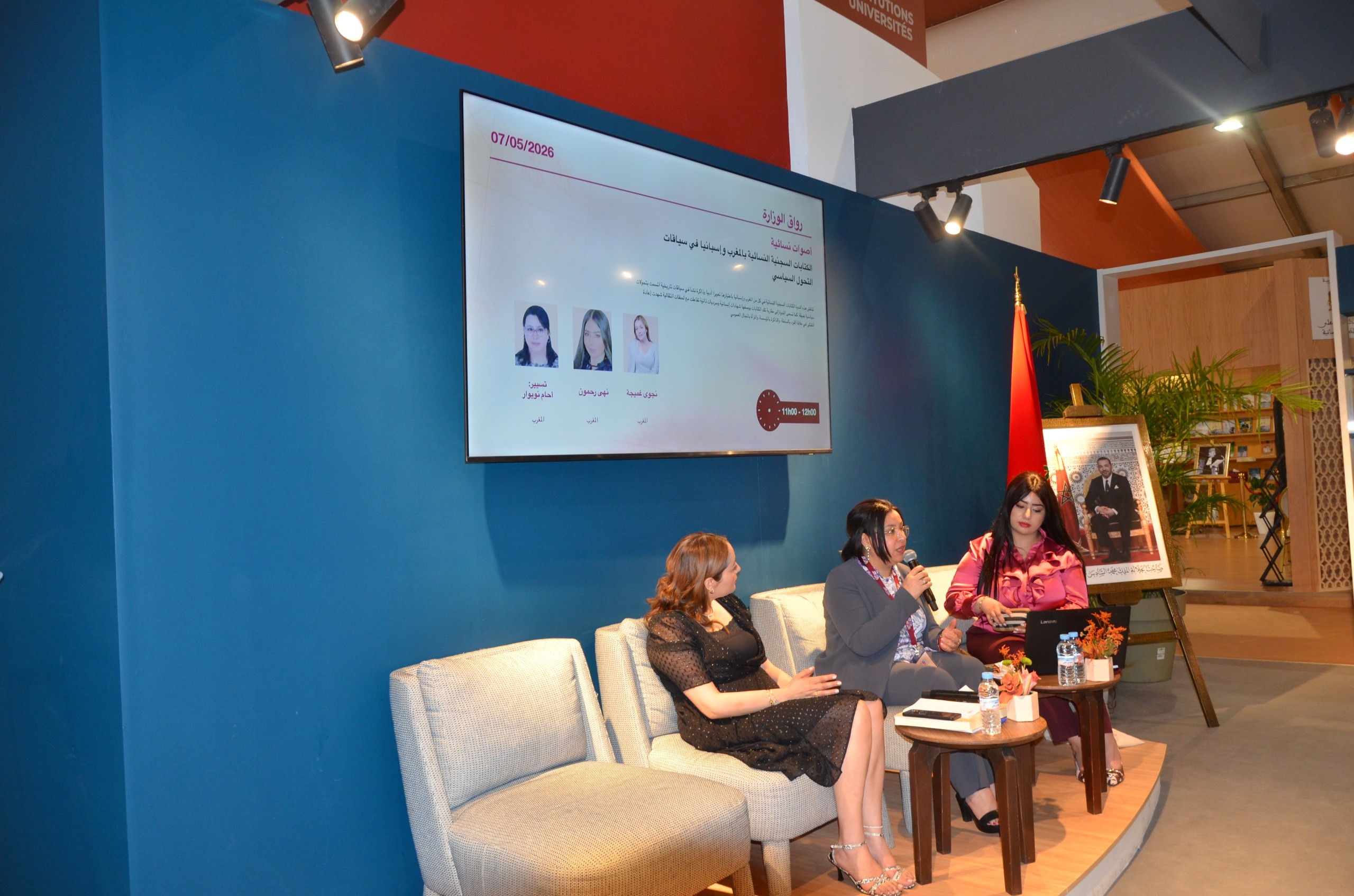
At the International Publishing and Book Fair, a powerful dialogue on women’s prison writing brought together former journalist and specialist in Spanish literature Najwa Ghmija and forensic science expert Nouha Rahmoun.
Najwa Ghmija explored how prison literature transforms individual suffering into collective memory, preserving histories of repression and trauma. She particularly emphasized the experience of imprisoned women, who endure a double isolation and a violation of both their feminine and personal identities.
For her, writing is a means for prisoners to rebuild themselves and reclaim their power, adding, “Writing is an intrusion into the isolation and darkness of prison.” Moreover, she highlighted that the credibility of prison literature lies in the prisoner’s memory.
In contrast, Nouha Rahmoun, inspired by her legal and human rights background, addressed the issue of women’s incarceration in Morocco through a legal and human rights perspective. She explained that although gradual improvements are being made regarding the needs of women prisoners, fundamental issues related to dignity, medical care, education, family visits, and protection against violence remain central concerns.
At the same time, she identified several persistent challenges faced by women in Moroccan prisons, including overcrowding, psychological pressure, and the difficulties of reintegration into society after release.
Finally, despite the diversity of perspectives presented, women’s prison literature emerges as a space where readers are invited to bear witness to a universal human experience with both psychological and social dimensions. Through writing, the prisoner transforms from a voiceless individual deprived of freedom into someone capable of expressing lived experiences. In this sense, writing becomes both an act of revival and a symbolic resistance against oblivion.