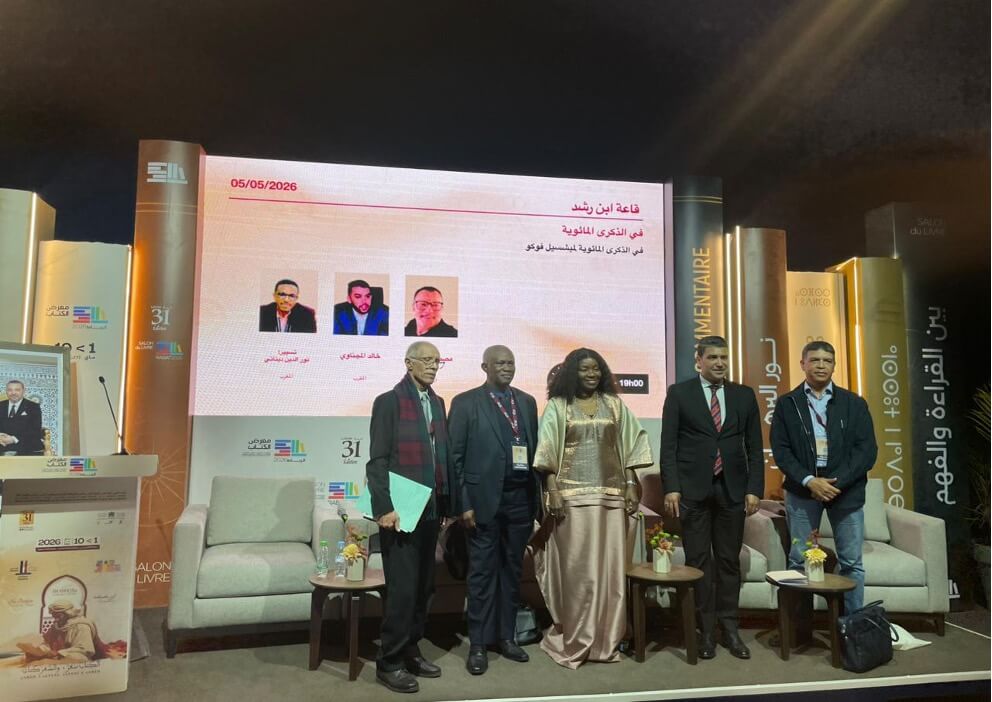
The discussion revolved around the preservation of African heritage, with a focus on intangible cultural heritage and Africa’s role within UNESCO frameworks.
It brought together four guests from Morocco, Tunisia, Mali, and Congo to discuss heritage, restitution debates, and the need for stronger African participation in global heritage systems.
Fatima Sou Sidibé highlighted the importance of intangible cultural heritage and the crucial role of women in its transmission. She described African heritage as living and oral, passed on by elders, especially grandmothers.
She stressed that digitalization must remain ethical and should not replace human transmission. “We should digitize but not dehumanize,” she said.
Abel Kouvouama said it is important to understand Africa “from within” and that oral memory is fragile. He described African identity as historical, imagined, and lived, with Congolese rumba linking memory, art, and diaspora connections, emphasizing its roots in slavery and cultural métissage.
Bilel Chebi and Smir Kafas focused on the UNESCO World Heritage system, particularly in relation to Rabat’s inscription as a World Heritage City, referring to the 1972 UNESCO Convention, as well as those of 2003 on intangible heritage and 1976 on movable heritage.
They emphasized that African heritage often combines landscape, spirituality, and living traditions that are not fully reflected in UNESCO’s historically Eurocentric criteria, contributing to Africa’s underrepresentation on the World Heritage List due to technical, financial, and institutional barriers.
Kafa presented heritage preservation as a continuous “virtuous circle” of identification, documentation, protection, and restoration, stressing that inscription is the result of a long process rather than an end goal.